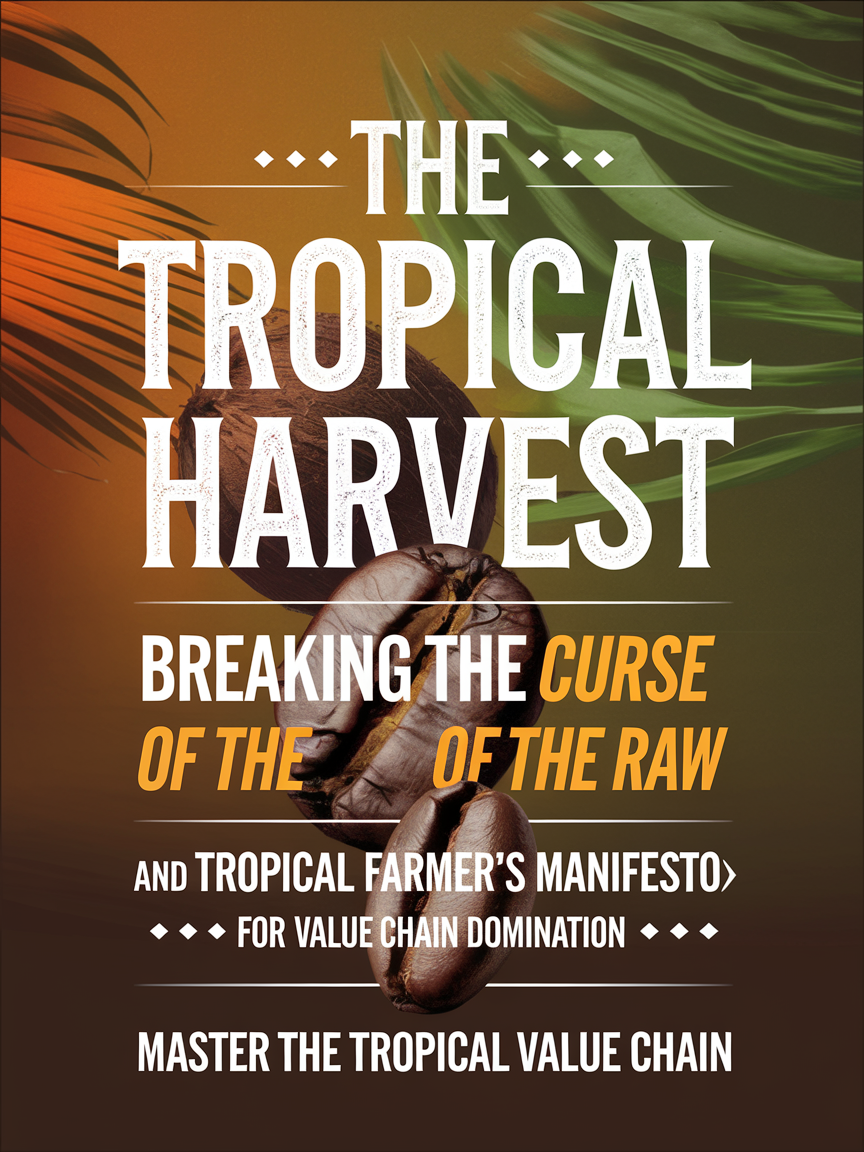
The Tropical Harvest: Breaking the Curse of the Raw and Tropical Farmer's Manifesto for Value Chain Domination
0 reviews
Chapters
6
Language
English - US
Genre
Published
January 31, 2026
Synopsis
The Master Prompts for Development 1. The Lament of the Raw Producer Prompt: "Write a visceral opening chapter in the tradition of Les Misérables, detailing the daily life of a cocoa or coffee farmer in the humid subtropics. Describe the 'Cycle of the Raw': the back-breaking labor, the exposure to volatile weather and pests, and the indignity of receiving pennies for a product that will be sold for dollars in a distant city. Use powerful imagery to illustrate that the farmer carries the heaviest burden of risk for the smallest sliver of the prize." 2. The Mirage of Capital and the Fortress of the Middleman Prompt: "Draft a narrative chapter titled 'The Invisible Wall.' It should follow an organized group of farmers attempting to secure a loan to buy processing machinery. Narrate their struggle against financial institutions that view raw land as a risk and processed value as a luxury. Contrast this with a secondary storyline about a foreign tech-agricultural firm that uses tropical fruits to create high-end extracts, showing the massive disparity in profit margins through a blend of storytelling and stark economic figures." 3. The Blueprint for the Tropical Value Chain Prompt: "Create a technical yet poetic guide within the book that outlines the transition from 'Worker' to 'Owner of the Chain.' Detail how farmers must organize into sophisticated collectives to control drying, refining, packaging, and branding. Use the term 'Tropical Sovereignty' to describe the shift from exporting ingredients to exporting brands. Include a list of 10 'High-End Disciplines' every tropical producer must master, such as traceability, organic certification, and luxury storytelling." 4. The Modern Conquistadors of Technology Prompt: "Write a comparative analysis chapter that uses 'The Tale of Two Orchards.' One orchard is in the tropics, selling raw fruit to a ship; the other is in a tech-forward nation (like the Netherlands or Israel) using technology to process that same fruit into high-end pharmaceuticals or gourmet products. Use this to ignite a fire of motivation, proving that the 'blessing' of the tropical climate is being harvested by those with the best tools, not those with the best soil."The 'Raw Product Trap' ensnares countless tropical farmers, forcing them into a cycle of low returns and limited growth. This book serves as an inspirational manifesto, empowering tropical and subtropical agricultural cooperatives and rural entrepreneurs to break free and seize control of their entire value chain. Carlos Alberto Itza, drawing upon decades of experience with leading international development organizations, provides a clear roadmap for transforming raw commodities into high-value products. Discover how strategic organization, the adoption of cutting-edge technology, and a deep understanding of market dynamics can unlock unprecedented prosperity for your community. This essential guide is crafted for forward-thinking farmers, ambitious rural entrepreneurs, influential policymakers, and the next generation of Agro-Tech innovators. It delves into practical strategies for vertical integration, leveraging digital tools for efficiency and market access, and building robust cooperative structures that amplify bargaining power. 'Harvesting the Future' is more than a book; it's a call to action, a blueprint for sustainable wealth creation, and a testament to the immense potential lying dormant in the tropics, waiting to be cultivated through knowledge, collaboration, and technological advancement.
More Books by the Author


Create Your Own Book
Inspired by what you've read? Turn your ideas into reality with FastRead's AI-powered book creation tool.
Start Writing Now