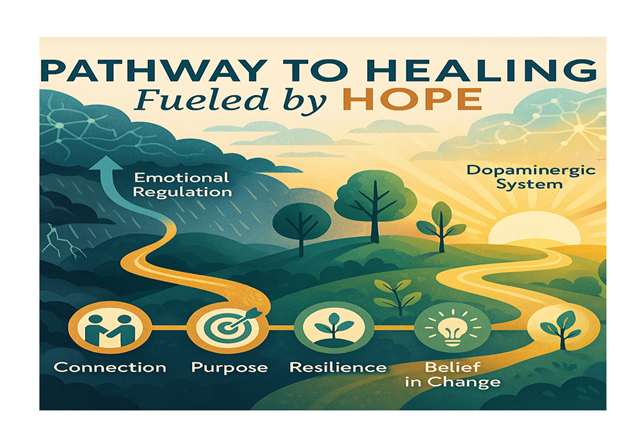
Hope as a therapeutic force: Beyond wishful thinking to active agency.
I’ll be direct with you, colleague-to-colleague. In the sacred space of the therapy room, our most advanced techniques and sophisticated diagnoses are nothing without the foundational human qualities that truly facilitate change (Rogers, 1957). We can possess the entire DSM as a map, but without the lantern of hope, the compass of faith, and the unshakeable ground of dignity, our clients and we will remain in the dark (American Psychiatric Association, 2013; Rhoton & Gentry, 2019).
In the labyrinthine journey of trauma recovery, hope often emerges as the faint, flickering lamp guiding clients through their darkest passages (Tedeschi & Calhoun, 2004). Yet, to truly leverage its transformative power, we must understand hope not as a passive wish or a naive optimism, but as a robust, neurologically grounded therapeutic force, an active agent propelling individuals toward a future marked by coherence and vitality (Snyder, 2002; Rhoton, 2019). This distinction is paramount, shifting our clinical gaze from merely alleviating despair to actively cultivating a dynamic, forward-moving orientation that reclaims inherent potential.