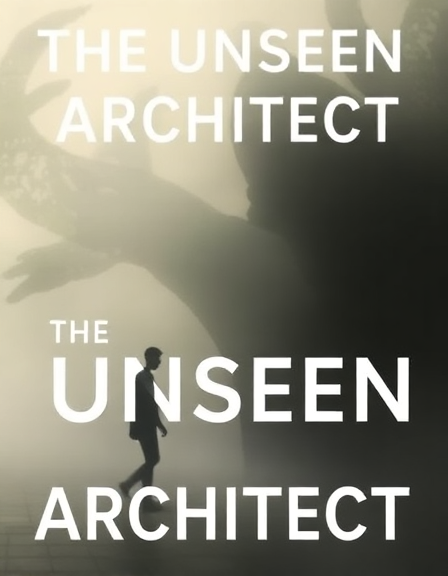
The Unseen Architect
0 reviews
Chapters
6
Language
English - US
Genre
Published
May 20, 2026
Synopsis
The story begins by introducing a quiet, emotionally unstable environment where something unseen feels consistently wrong. From the opening chapter, there is an immediate sense that perception itself cannot be trusted. The world feels slightly distorted in ways that are difficult for both the characters and the reader to define. The main character, Cam, is introduced as someone already dealing with internal emotional strain, which subtly affects how he interprets his surroundings. Small inconsistencies appear in his environment—sounds that feel delayed, shadows that seem to linger too long, and moments where his memory of events does not fully align with what others describe. These early signs suggest that something is present, but not yet fully visible or understood. The chapter establishes the central concept that fear and emotion are not just reactions in this world—they actively shape what people experience. In the second chapter, the presence known as “Hide” begins to assert itself more clearly, though still without a defined physical form. It behaves less like a creature and more like an environmental force that interacts with perception. The more unstable a person’s emotional state becomes, the more distorted their reality grows. Cam begins noticing that his thoughts feel “reflected” back at him through his surroundings, as if the environment is responding to his internal fears. Other individuals around him begin experiencing different versions of the same space, each shaped by their own psychological state. What one person sees as empty, another may perceive as crowded or threatening. This establishes one of Hide’s core abilities: emotional environments that amplify and reshape hallucinations based on personal vulnerability. By the third chapter, the distortions intensify and begin to overlap between individuals. Cam’s experiences grow increasingly unreliable, and he struggles to determine whether certain events actually occurred or were constructed by his mind under influence. The environment starts to “contaminate” perception more aggressively, causing emotional feedback loops—fear leads to distortion, which leads to more fear. Cam encounters moments where time feels inconsistent, such as conversations repeating with slight variations or locations subtly changing between exits and returns. The idea of Hide as a passive presence shifts into something more invasive, as though it is studying emotional reactions and refining how it manipulates perception. Cam becomes increasingly isolated, even when physically surrounded by others, because no shared reality can be fully trusted. In the fourth chapter, the psychological and perceptual collapse reaches a critical point. Cam experiences what appears to be a direct confrontation with the entity’s influence, though it is unclear whether this is literal or a final mental break. The environment becomes highly unstable, blending fear, memory, and distorted sensory input into a continuous, shifting experience. Cam’s emotional state peaks into extreme distress, and the distortions respond in kind, becoming more aggressive and personalized. It is here that Cam’s apparent death is implied rather than explicitly shown. The narrative does not present a clear physical confirmation, but instead frames his disappearance through fragmented perception, suggesting he may have been consumed, erased, or mentally overwritten by Hide. The ambiguity is intentional, leaving the reader uncertain whether Cam has died in a physical sense or has simply been removed from a shared reality. In the fifth chapter, the aftermath of Cam’s implied disappearance is presented through external perspective and indirect confirmation. Other characters and systems within the story begin acknowledging something happened, but details are inconsistent and incomplete. The most grounding moment comes through the introduction of news reports or public awareness of an incident, which attempts to frame Cam’s disappearance in rational terms. However, these explanations feel incomplete, as if they are describing only fragments of a much larger and more incomprehensible event. Even in these more “objective” accounts, inconsistencies persist, reinforcing the idea that Hide does not simply affect individuals—it distorts collective understanding as well. The chapter ends with a lingering uncertainty about what actually occurred, solidifying the central theme that reality itself has been compromised, and that what is lost may not be fully recoverable or understandable through normal means..
Create Your Own Book
Inspired by what you've read? Turn your ideas into reality with FastRead's AI-powered book creation tool.
Start Writing Now