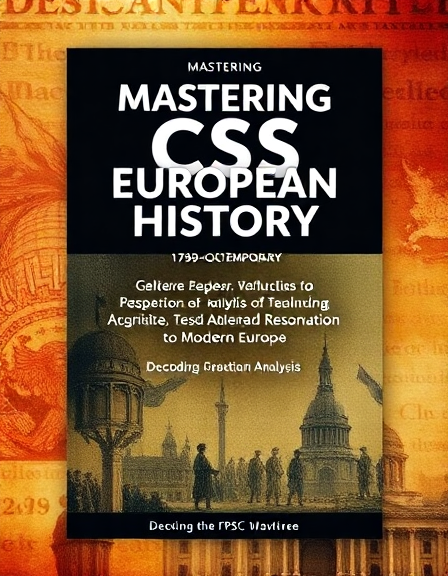
Mastering CSS European History (1789–Contemporary): A Syllabus-Driven Analysis | Decoding the FPSC Narrative: From the French Revolution to Modern Europe
0 reviews
Chapters
4
Language
English - US
Genre
Published
February 24, 2026
Synopsis
The Ultimate, Analytical Companion for the CSS European History Examination. This volume is meticulously engineered to serve as the single, authoritative preparation tool for the CSS European History paper. Completely bound to the official FPSC syllabus, this book eliminates the clutter of generic history, focusing exclusively on the geopolitical shifts, socio-economic transformations, and critical events that examiners test year after year—spanning from 1789 to the contemporary era. Structure Strictly Aligned with the FPSC Syllabus: The narrative is strategically divided to mirror the official CSS curriculum: Part I (1789–1914): Offers an in-depth, analytical look at the French Revolution, the Napoleonic Era, the Congress of Vienna, and the intricate web of 19th-century nationalism. It dedicates comprehensive coverage to the Unification of Italy and Germany, and thoroughly decodes "The Eastern Question," detailing the decline of the Ottoman Empire and its profound impact on European diplomacy. Part II (1914–Contemporary Europe): Navigates the complex causality of the World Wars, the Russian Revolution, and the ideological battlegrounds of the Cold War. Crucially, it extends into the modern era, providing detailed analyses of Post-Cold War Europe, the evolution of the European Union, the 2008–2012 Eurozone financial crises, Brexit, and the contemporary geopolitical challenges defining Europe today. Grounded in FPSC-Recommended Texts: To ensure aspirants produce the high-quality, argumentative answers demanded by examiners, this text synthesizes core arguments, perspectives, and factual data directly from standard FPSC-recommended authors (such as H.L. Peacock, Gordon A. Craig, and Stuart Miller). It distills these dense volumes into highly readable, exam-focused chapters without sacrificing academic rigor. Driven by Past Papers & Examiner Reports: This is not just a recounting of history; it is a strategic guide on how to write history for the FPSC. Past Paper Integration: Every chapter is framed around the thematic questions asked in CSS past papers over the last two decades, showing students exactly how historical facts are translated into high-scoring, 20-mark answers. Examiner Report Solutions: Directly addressing the frequent complaints found in official FPSC Examiner Reports, the text trains aspirants to move away from descriptive, rote memorization. It emphasizes cause-and-effect analysis, chronological coherence, and the formulation of critical, well-structured arguments in standard English. Whether you are deciphering Bismarck’s alliance system or analyzing the structural flaws of the contemporary European Union, this book equips you with the exact historical knowledge, vocabulary, and analytical frameworks required to maximize your score in the CSS European History paper
Create Your Own Book
Inspired by what you've read? Turn your ideas into reality with FastRead's AI-powered book creation tool.
Start Writing Now